Skip to content
Request a demo

For coaching staffs and athletic programs

Your whole roster, on one screen.

Every athlete checks in from their phone in 30 seconds. Your staff sees who's ready to practice and play, builds the plan and the game-day roster, and keeps clearances current.

Opens an email to our team, ready to send. We reply within one business day. Or write to [email protected].

See the platform

Choose your sport

87% of concussions in Argentine rugby go unreported.

ArgentinaArgentine Rugby Union (UAR), 2019 survey of 5,398 players. See the source

In Vestuario: every squad, first team to development · forwards and backs, by position · physicals and clearances up to date

Concussion is the most common injury in women's college field hockey: 8.6% of all injuries.

USANCAA, five seasons, 2014–2019. Journal of Athletic Training, 2021. See the source

In Vestuario: women's and men's teams · goalkeepers, defenders, midfielders and forwards · clearances up to date

A 25-player professional squad can expect about 50 injuries per season. And teams with fewer injuries earn more points.

EuropeUEFA Elite Club Injury Study. British Journal of Sports Medicine, 2011 and 2013. See the source

In Vestuario: every squad · goalkeepers, defenders, midfielders and forwards · clearances up to date

The ankle accounts for 1 in 5 injuries in men's college basketball.

USAMorris et al., Journal of Athletic Training, 2021 (NCAA men's basketball, 2014–2019). See the source

In Vestuario: every squad · guards, forwards and centers · clearances up to date

Nearly half of elite volleyball players play through overuse knee pain.

NorwayJumper's knee: 44.6%. Lian et al., American Journal of Sports Medicine, 2005. See the source

In Vestuario: every squad · setters, opposites, middles, outsides and liberos · clearances up to date

Standard injury records catch only 1 in 10 overuse problems.

NorwayClarsen, Myklebust and Bahr, British Journal of Sports Medicine, 2013 (handball, volleyball and three other sports). See the source

In Vestuario: every squad · goalkeepers, backs, wings and pivots · clearances up to date
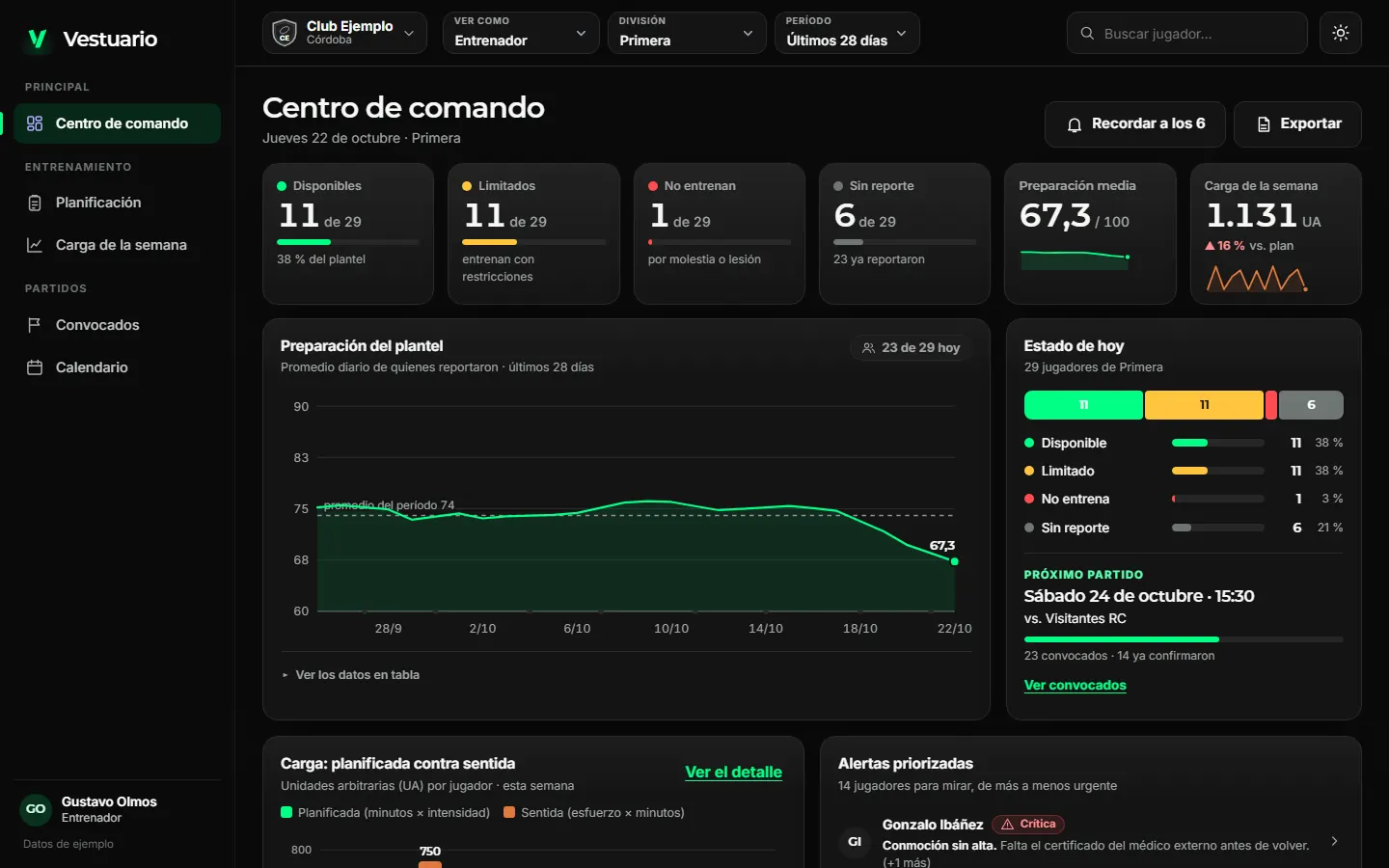
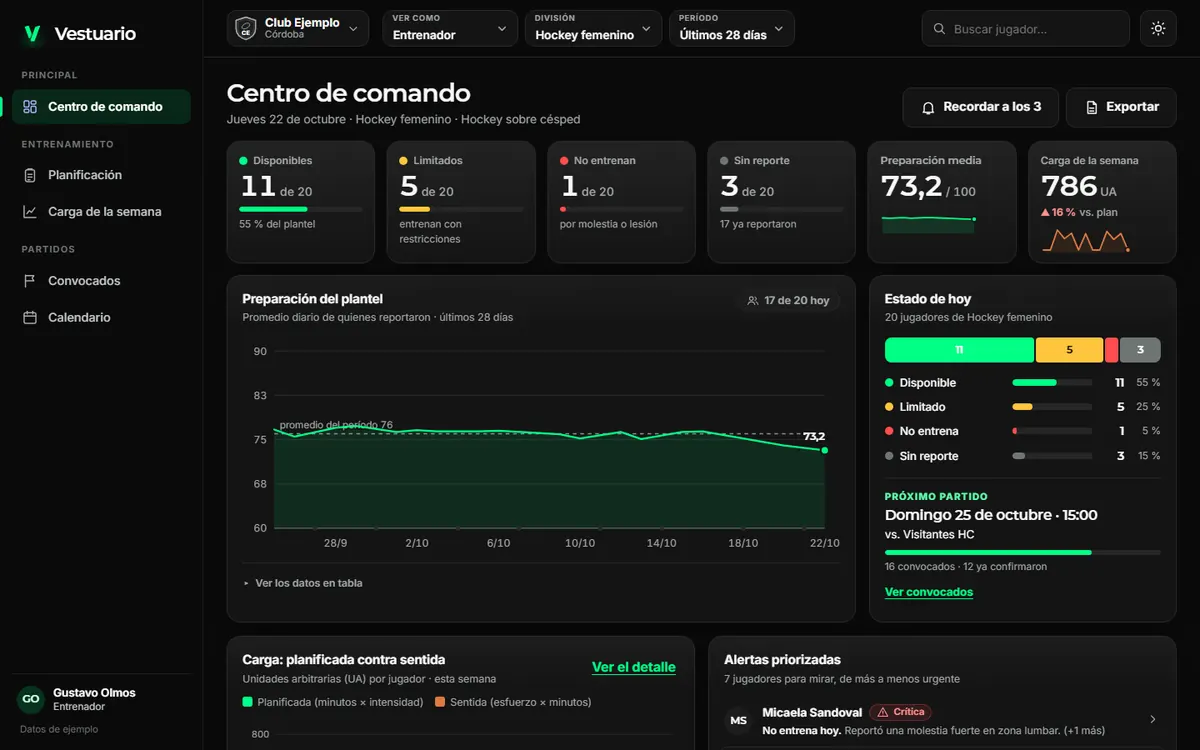
Vestuario roster status: available, limited, out and no check-in, team readiness over the last 28 days, today's status and the next game. Opens the full screenshot Roster status for a women's field hockey team: 11 available, 5 limited, 1 out and 3 with no check-in. Opens the full screenshot
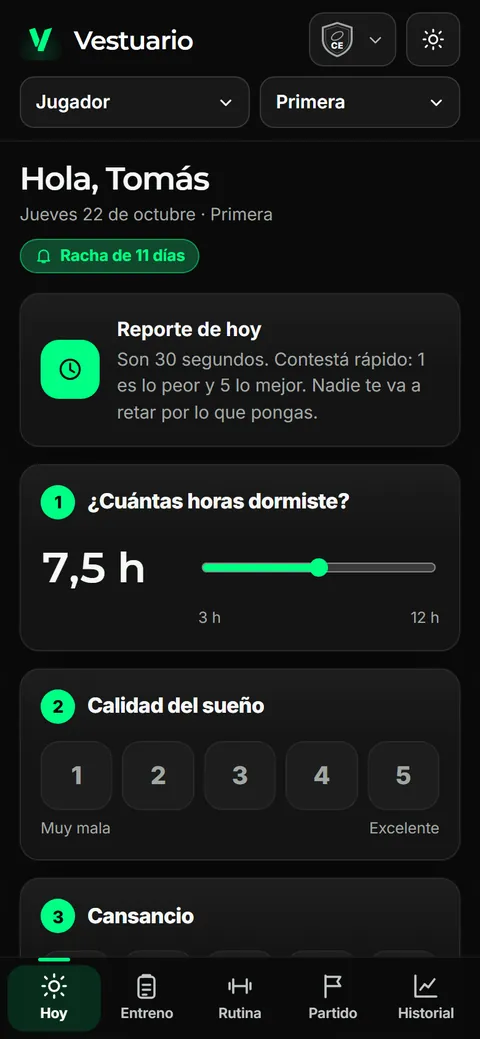
An athlete's daily check-in on the phone: hours of sleep and sleep quality, from 1 to 5
Vestuario screens with sample data, shown in the Spanish version.

Demo

See Vestuario in two minutes.

A short walkthrough of the platform, with sample data.

Demo video coming soonIn the meantime, we'll walk you through it live.

The platform

Eight modules. One team.

From each athlete's check-in to game day, head coaches, athletic trainers and strength coaches work from the same data, and each role sees what it needs.

In the demo today: seven modules.Coming with the pilot: push notifications and exports.

Daily check-in

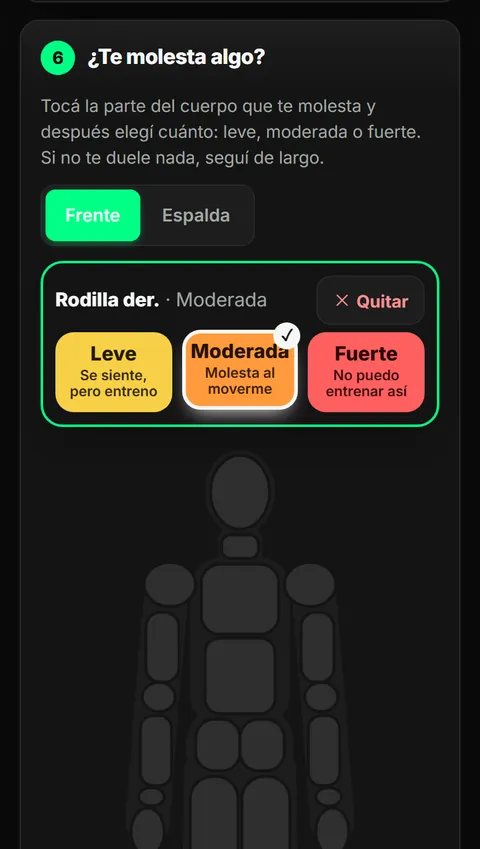
Every athlete reports how they feel in 30 seconds: sleep, fatigue, muscle soreness and stress. If something hurts, they mark it on a body map. After practice, they rate the session's effort.

  • From the phone, nothing to download
  • A simple 1-to-5 scale
  • Check-in streaks to build the habit
An athlete's daily check-in: hours of sleep and sleep quality

Roster status

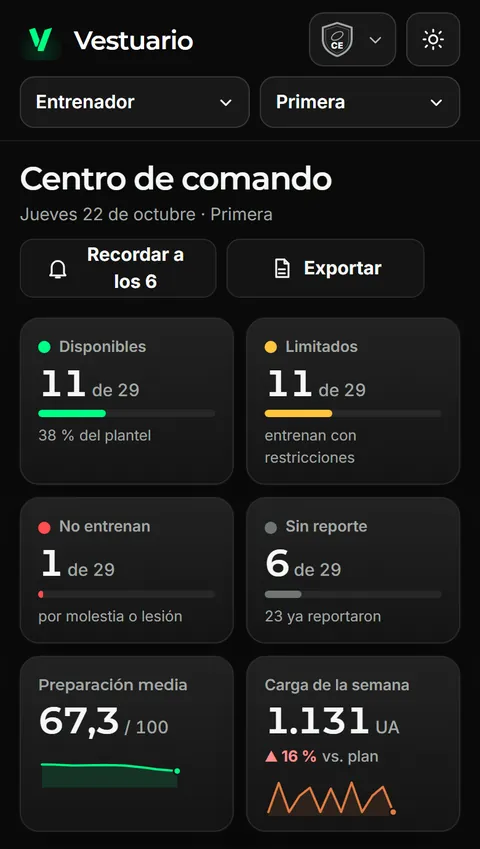
The roster traffic light before you get to the field: who's available, who's limited, who's out and who hasn't checked in. Alerts are sorted from most to least urgent.

  • Each athlete compared with their own baseline
  • Team readiness over the last 28 days
  • Planned load against perceived load
  • Acute:chronic workload and each athlete's trend
Roster status for a women's field hockey team: 11 available, 5 limited, 1 out and 3 with no check-in. Opens the full screenshot

Planning & calendar

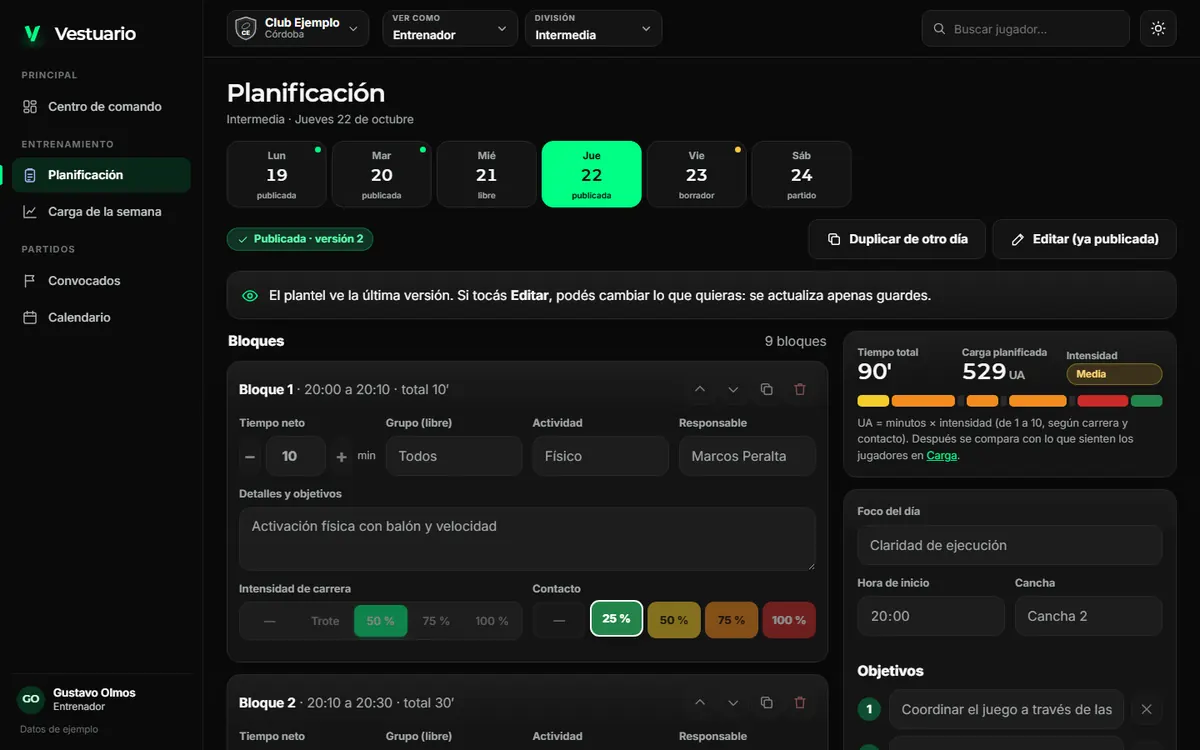
The day's plan in blocks, with time, group, activity, intensity and who runs each one. Publish it, and the team sees it on their phones.

  • Athletes always see the latest version
  • Duplicate a planned day in one tap
  • Planned load is calculated automatically
  • Sessions and games on the team calendar
Weekly plan with blocks, times, intensity and who runs each block. Opens the full screenshot

Workouts

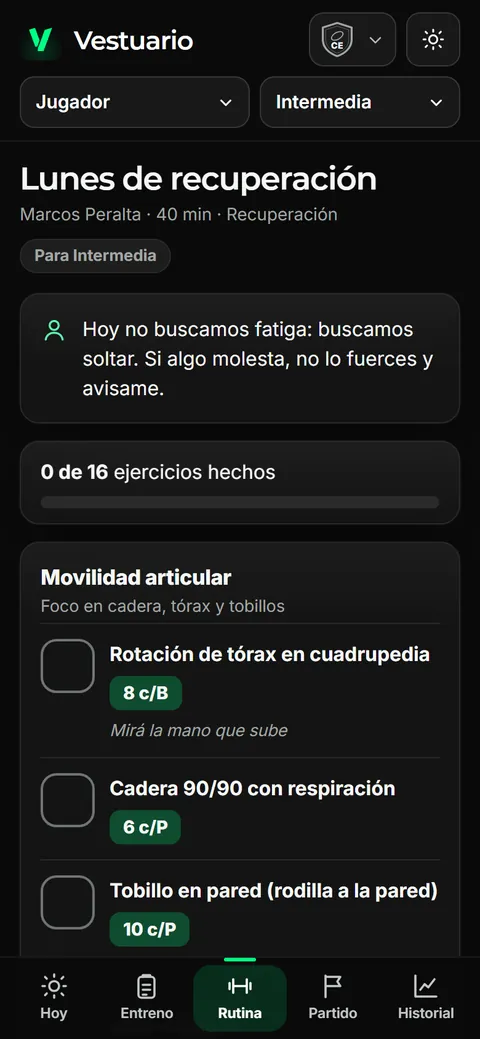
The strength and conditioning coach builds the workout, assigns it by team and sees who completed it. Athletes follow it on their phones and check off each exercise.

  • Sets, reps and a coaching cue for each exercise
  • Strength, activation and recovery
  • Completion tracking by team
A recovery workout on an athlete's phone, with exercises to check off

Game-day rosters

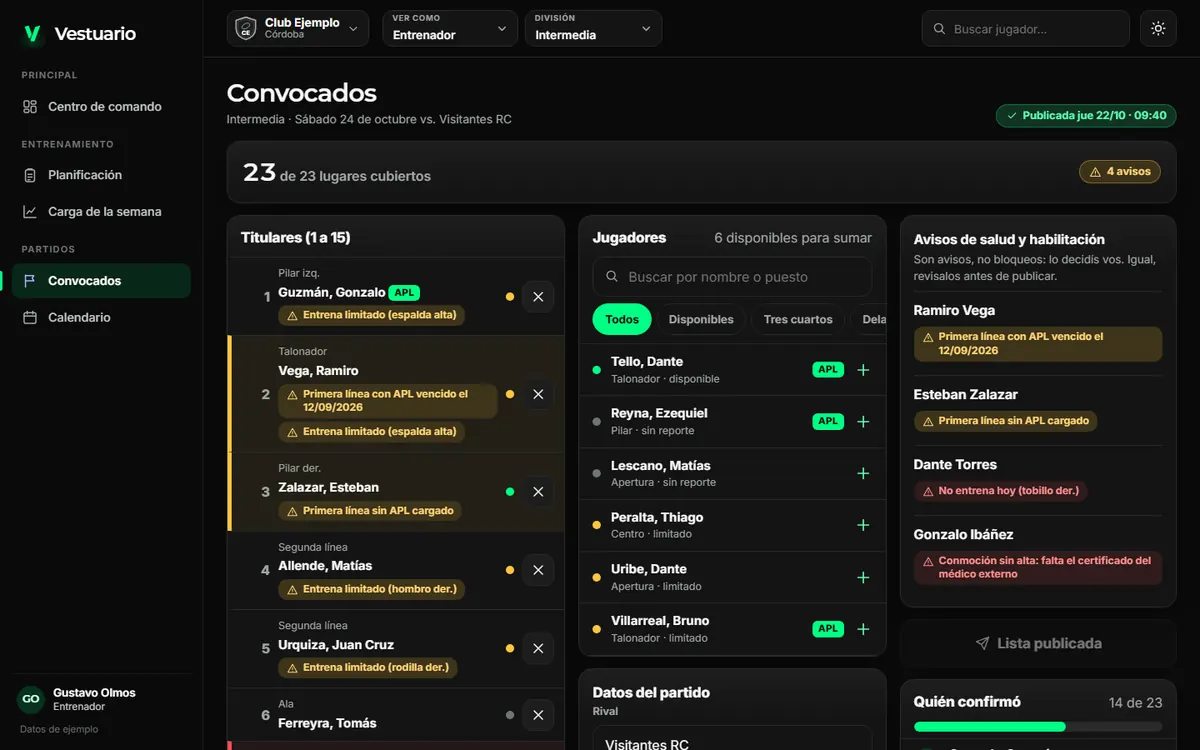
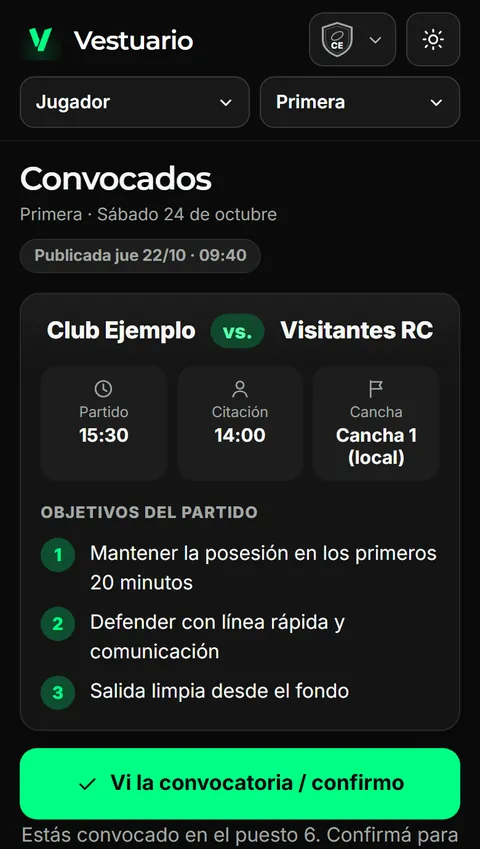
The game-day roster with starters and substitutes, each athlete's confirmation, and health and clearance flags before you publish it.

  • A flag if a physical or clearance is missing
  • A flag if a concussion hasn't been cleared
  • See who has viewed it and who has confirmed
Game-day roster with starters, available athletes to add, and health and clearance flags. Opens the full screenshot

Athlete file & clearances

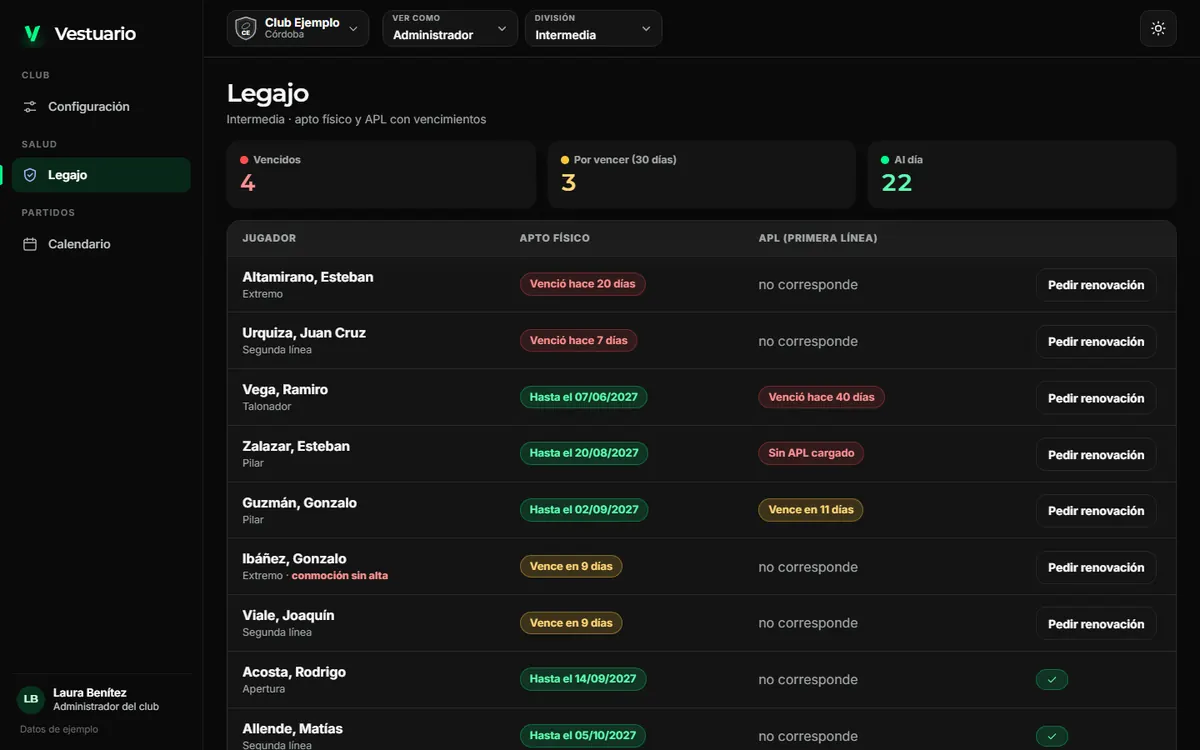
Physicals and clearances with their expiration dates in view: expired, expiring soon and current. So no one takes the field with an expired physical. Vestuario doesn't replace the physical: it keeps it current.

  • Expired, expiring soon and current, by team
  • A flag for any concussion not yet cleared
  • Health data only with signed consent
Athlete file with physicals and clearances: 4 expired, 3 expiring soon and 22 current. Opens the full screenshot

Concussion protocol

Any staff member can log a concussion from their phone. The athlete is flagged "no practice, no games", the graduated return-to-play stages are tracked with minimum days by age, and the game-day roster won't let them be selected until a physician clears them.

  • Graduated return-to-play stages following World Rugby's protocol, configurable for each governing body
  • A physician, on staff or external, confirms the clearance
  • Concussion history in the athlete file

Notifications Coming with the pilot

Push notifications reach each athlete's and staff member's phone: the daily check-in, the published plan, the game-day roster and expiring clearances. Everyone gets only what's theirs.

  • A reminder for anyone who hasn't checked in
  • A notice when the plan or the roster is published
  • Expiring clearances, ahead of time

How it works

Three moments, every day.

Designed with coaches, for the real rhythm of a season: the check-in before leaving home, the decision before practice, and game day.

  1. Body map on an athlete's phone, with the right knee marked as moderate soreness

    01

    The athlete checks in

    Before leaving home, 30 seconds on the phone: how they slept, how they feel and, if something hurts, where and how much.

  2. Roster status on a coach's phone: available, limited, out and no check-in

    02

    The staff decides

    Before practice, the roster traffic light and the alerts. The plan adjusts to the data, and the call is always the staff's.

  3. Game-day roster on an athlete's phone, with the button to confirm

    03

    Game day

    The game-day roster goes out with health flags resolved. Each athlete confirms from their phone, and the staff sees who has seen it.

The research

What the research says, sport by sport.

One finding per sport, with its source and where the study was done.

  • RugbyArgentina

    87%

    87% of concussions in Argentine rugby go unreported.

    Argentine Rugby Union (UAR), 2019 survey of 5,398 players. Only 13% of players with a concussion were removed from play. See the source

    In Vestuario: the athlete file and the game-day roster flag any concussion that hasn't been cleared.

  • Field hockeyUSA

    8.6%

    Concussion is the most common injury in women's college field hockey: 8.6% of all injuries.

    NCAA, five seasons, 2014–2019. Journal of Athletic Training, 2021. See the source

    In Vestuario: the game-day roster flags any athlete with a concussion that hasn't been cleared.

  • SoccerEurope

    50

    A 25-player professional squad can expect about 50 injuries per season. And teams with fewer injuries earn more points.

    UEFA Elite Club Injury Study. British Journal of Sports Medicine, 2011 and 2013.

    College soccer

    Only 1 in 5 soccer players who had concussion symptoms realized it was a concussion. Delaney et al., Clinical Journal of Sport Medicine, 2002 (Canadian university soccer players). See the source

    Women's soccer has the second-highest concussion rate of 23 NCAA sports. And it climbed during the study. NCAA, 2014–2019. American Journal of Sports Medicine, 2022. See the source

    In Vestuario: the daily traffic light shows who's available before every practice.

  • BasketballUSA

    1 in 5

    The ankle accounts for 1 in 5 injuries in men's college basketball.

    Morris et al., Journal of Athletic Training, 2021 (NCAA men's basketball, 2014–2019). See the source

    In Vestuario: the body map logs every complaint, including the ankle that's "nothing".

  • VolleyballNorway

    44.6%

    Nearly half of elite volleyball players play through overuse knee pain.

    Jumper's knee: 44.6%. Lian et al., American Journal of Sports Medicine, 2005. See the source

    In Vestuario: the daily check-in captures the pain that doesn't keep anyone out of a game, but adds up.

  • HandballNorway

    1 in 10

    Standard injury records catch only 1 in 10 overuse problems.

    Clarsen, Myklebust and Bahr, British Journal of Sports Medicine, 2013 (handball, volleyball and three other sports): 40 problems with standard recording, 419 with a weekly question to each athlete. See the source

    In Vestuario: that's what the daily check-in does. It asks every athlete how they feel, instead of waiting for a missed game.

Data and privacy

Health data, with clear rules.

Health data encrypted; hosted in the EU today, US hosting available for US programs. Here is how Vestuario handles it, and it's all in writing in the agreement with each program.

  • Signed consent firstNo athlete logs health data until they sign the consent form, and athletes under 18 also need a parent or guardian's signature. It's voluntary: saying no never keeps anyone out of practice or off a roster.
  • Each role sees its ownAthletes see their own data. Head coaches see the traffic light and who can play, without the medical detail. Athletic trainers, strength coaches and team physicians see the detail.
  • Your data stays yoursEach program owns its data. Vestuario stores it on the program's behalf and uses it for nothing else. One program's data never mixes with another's.
  • EncryptedConnections are always encrypted, and health and contact data are stored encrypted.
  • Hosting and backupsHosted in the European Union (Frankfurt, Germany) today, with US hosting available for US programs. A daily encrypted backup, kept off the main server, is in place before your first data goes in.
  • If you leaveYour program gets all of its data back in a spreadsheet, and only then is it deleted.

Pricing

Simple pricing for small programs.

Tell us about your program and we'll send you a written quote within one business day.

FAQ

What coaching staffs ask us.

How much does it cost?

Simple pricing for small programs. Tell us about your teams and roster size, and we'll send you a written quote within one business day. Ask for pricing

How do we get started?

Your program uploads its roster from the spreadsheet you already have, or one athlete at a time, and sets up its teams and staff. Each athlete joins with their team's QR code. The Vestuario team guides the setup and trains your staff.

What if athletes don't check in?

That's why checking in takes 30 seconds, from the phone, with nothing to download. Check-in streaks help build the habit, and roster status shows who hasn't checked in before practice. Automatic reminders to athletes' phones are coming with the pilot.

Do athletes need to download an app?

No. Vestuario isn't in the app stores: it opens in the phone's browser and can be added to the home screen in one tap, like any other app. Checking in takes 30 seconds.

Which sports does it support?

Rugby, field hockey, soccer, basketball, volleyball and handball. Each program sets up its own teams, training days and staff, and can run several sports at once, each with its own setup. Every staff member sees the teams they're assigned to, one or all of them.

Who owns the data, and where is it stored?

Your program owns it. Health data is encrypted and hosted in the EU today (Frankfurt, Germany), and US hosting is available for US programs. If you leave, you get all of your data back in a spreadsheet before anything is deleted.

Bring Vestuario to your program.

A 15-minute demo by video call. We reply within one business day.

Prefer to write directly? [email protected]